
Jetyush Barik: A Remarkable Journey of Language, Learning and Potential
When Jetyush Barik joined Happy Hands School for the Deaf in 2022, shortly after the COVID-19 pandemic, he became a child who immediately sparked our curiosity. As academics and educators working in Deaf education, we are very familiar with the remarkable achievements often observed among Deaf children of Deaf parents—children who have had early and natural access to sign language from birth. Jetyush’s journey, however, has made us look at this question from a different perspective.
Jetyush comes from a hearing family where his parents do not use sign language. When he joined Happy Hands School, he had virtually no access to Indian Sign Language. Yet, within four years, he has surprised and inspired us with the breadth of his development.
His achievements extend far beyond the classroom. He has developed exceptional interest and ability in chess, reading, general knowledge and academic learning. At the same time, he has become known for his discipline, compassion, creativity and willingness to help others.
He is a deeply curious and studious child who often demonstrates an impressive understanding of subject matter. In several areas, his academic performance has even surpassed that of children who entered school with early exposure to sign language through Deaf parents.
🏆 A National Achievement on the International Day of Sign Languages
Today, 23 September, the International Day of Sign Languages, Jetyush has given us another reason to celebrate.
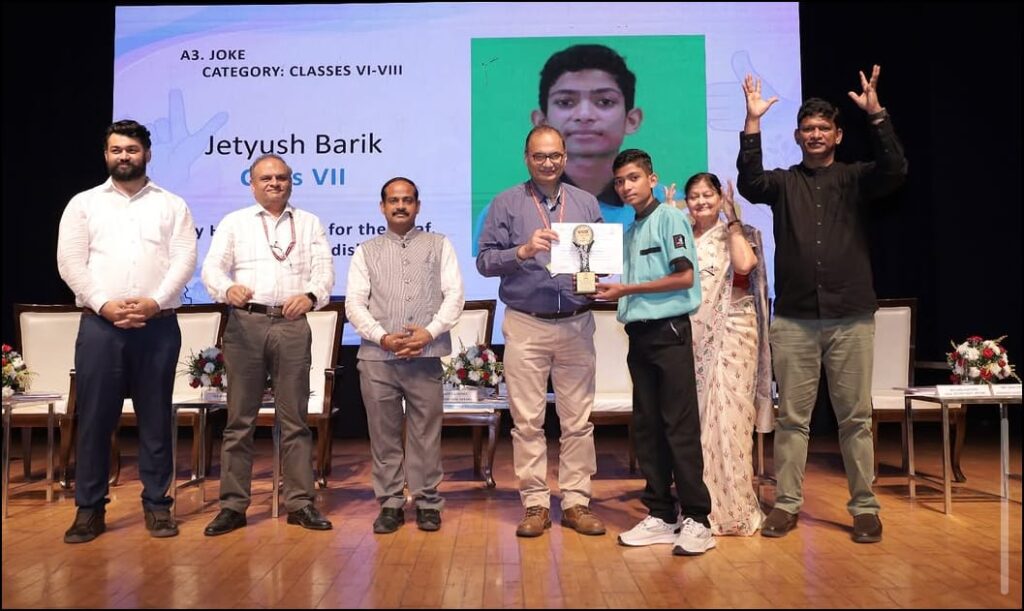
He has been awarded First Position at the national level in a Sign Language competition in the Class VI–VIII category, securing First Position in the Joke category.
For Happy Hands School, this is a moment of immense pride.
A child who arrived at school without access to sign language has, within four years, reached a level where he can compete nationally in sign language and secure first position in his category.
Jetyush: A Child Who Raises New Questions
For us, Jetyush represents something much more significant than individual academic success. His development offers an important opportunity to examine what can happen when a Deaf child who has experienced limited early access to an accessible language is subsequently provided with sustained access to Indian Sign Language, a rich linguistic environment, appropriate pedagogy and opportunities to learn according to his interests and abilities.
Jetyush has, in many ways, raised new questions for research and academic review.
What happens when a child who enters school with little or no sign language is provided with consistent and meaningful access to a natural language?
- How rapidly can linguistic, cognitive, academic and social development progress?
- What role do motivation and individual differences play?
- How important are pedagogy and the school environment?
- What role does interaction with Deaf peers play in language development?
- How should we understand the relationship between early language access and later educational achievement?
We do not claim that Jetyush provides all the answers. Rather, his journey challenges us to ask better questions.
Perhaps the “magic” lies not in one single factor, but in the interaction between the child’s own curiosity and abilities, meaningful access to language, an inclusive and stimulating educational environment, dedicated teachers, supportive peers and the opportunity to learn without communication barriers.
Jetyush has reminded us that a child’s starting point does not necessarily determine his destination.
Today, on the International Day of Sign Languages, as we celebrate his national achievement, we also celebrate the questions he has raised for us as educators and researchers.
For Happy Hands School, Jetyush is not only a national winner. He is becoming a living story of possibility—and perhaps, most importantly, a new subject for our own learning and research.